Stop counting.
The labels are guessing too.
Nobody knows exactly how many calories are on their plate. The label is a legal tolerance, not a measurement. The database entry is somebody else’s recipe. The gram-by-gram log you kept for three days was a guess with more decimal places.
So Roughly doesn’t ask you to count. You tell it what you ate, the way you would tell a person, and it works the rest out — and it says plainly that the numbers are estimates, because they are.

How it works
Say what you ate
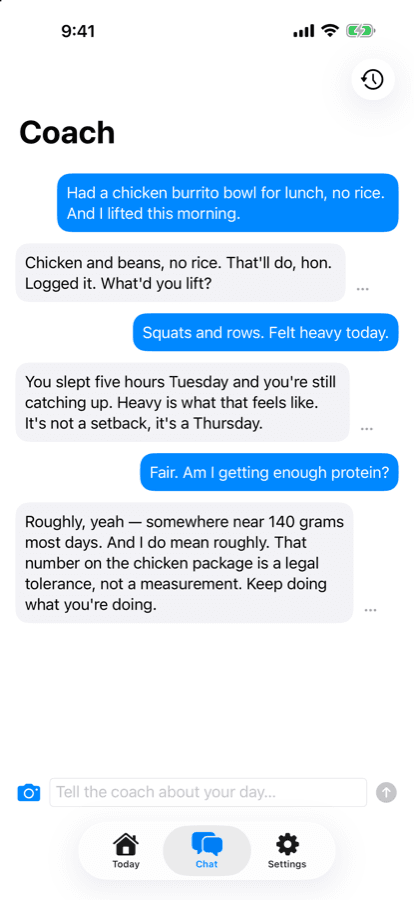
In your own words, whenever you think of it. “Two eggs and a coffee.” “Chicken burrito bowl, no rice.” No serving sizes to look up, and the coach estimates what you left out rather than interrogating you about it.
Or photograph it
Point the camera at the plate. The coach tells you what it read and what it reckons that comes to. Nothing is logged until you say so.
Check Today
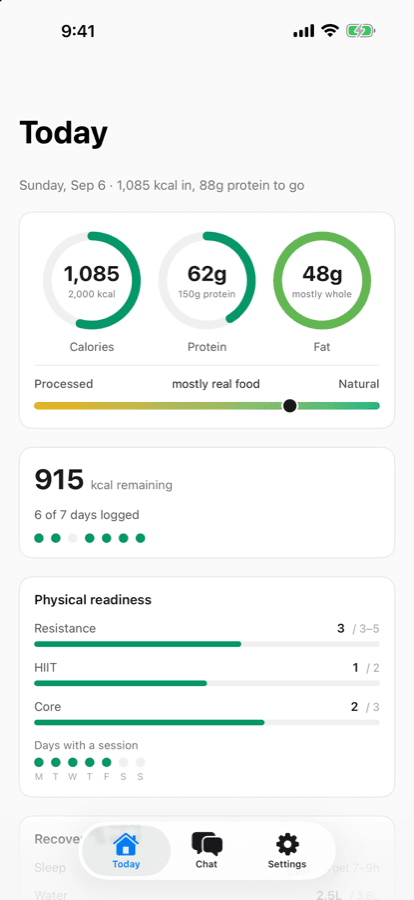
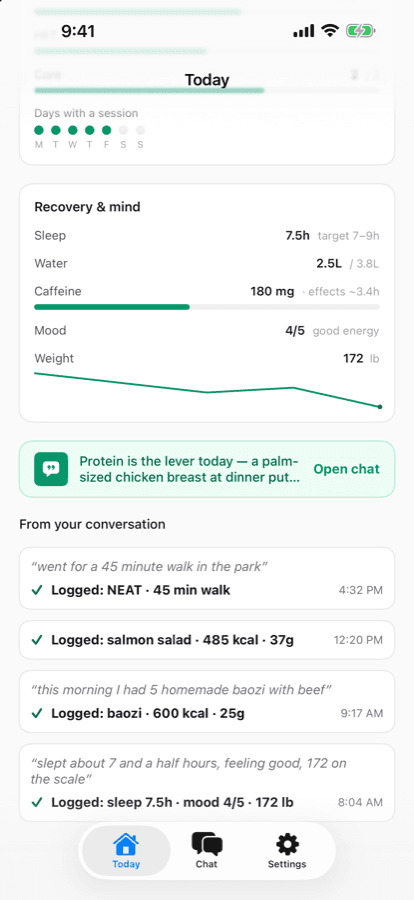
Rings, training bars and a weight trend — and under them, the sentences you actually typed beside what was logged from each one. Every number traces back to something you said.
Log by talking
“Chicken burrito bowl, no rice, and I lifted this morning” is a complete entry. No forms, no barcodes, no serving sizes to look up. The conversation is the log.
A coach that remembers
It has your history — what you ate, how you trained, what you said last week — and answers in that context rather than reciting generic advice. It is brisk, a little dry, and never on the side of the food label.
Receipts under every number
Below the graphs sits what you actually said, next to what was logged from it. Nothing is inferred without showing its source.
No badges. No nagging.
There is a row of dots showing which days you logged, because that is a fact worth seeing. It is not a score, nothing resets it, and no notification will ever mention it. No advertising, no analytics SDK, no selling your data to anybody. Sign in with Apple only, and one button in Settings erases all of it.
Questions
- How accurate are the numbers?
- They are estimates, and the app says so wherever it shows one. That is not a hedge — a nutrition label is a legal tolerance rather than a measurement, and a database entry is somebody else’s recipe, so every calorie figure you have ever seen was an estimate too. Roughly is honest about it instead of printing a decimal place it has not earned.
- What does it cost?
- A subscription, with the first week free: $7.99 a month or $79.99 a year, which is about two months off. It pays for the parts that cost money to run - the coach's replies, reading a meal photo and the weekly check-in. Prices shown are US; the App Store shows yours. Everything you have logged stays readable whether or not you keep it, and Settings cancels at any time.
- Do I have to weigh food or scan barcodes?
- No. You describe the meal the way you would to a person — "chicken burrito bowl, no rice, and I lifted this morning" — and the coach works out the rest. There is no form, no barcode scanner and no database of foods to search.
- Is this medical advice?
- No. Roughly is a general-wellness diet and training coach, not a clinician and not a regulated medical device. It does not diagnose, treat, prevent or monitor disease. Talk to a doctor or a registered dietitian before changing how you eat or train, particularly if you have a health condition or any history of disordered eating.
- What happens to my data?
- Sign in with Apple is the only sign-in, and Hide My Email works normally. There is no advertising, no analytics SDK and no data broker. One button in Settings deletes the account and everything in it — meals, chat, check-ins and measurements — immediately, not by emailing support.
Roughly is a coach, not a clinician. Its estimates are approximations and nothing it says is medical advice, diagnosis or treatment. Talk to a doctor or a registered dietitian before changing how you eat or train — particularly if you have a health condition or any history of disordered eating.